 Add to Chrome
 Add to Firefox
 Add to Edge
ReTool-Video: Recursive Tool-Using Video Agents with Meta-Augmented Tool Grounding
May 13, 2026
Video understanding requires active evidence seeking, motivating tool-augmented video agents for temporal reasoning, cross-modal understanding, and complex question answering. Existing video agents have improved video reasoning with retrieval, memory, frame inspection, and verifier tools, but they still face two limitations: (1) a coarse tool space that lacks fine-grained operations for compositional reasoning; and (2) a flat action space that forces high-level video intents into primitive executable tool calls. In this paper, we address these challenges with two complementary designs. First, we construct a MetaAug-Video Tool Library (MVTL), an extensible tool library with 134 registered tools, including 26 base tools for general multimodal signal processing and 108 meta tools for filtering, aggregation, reranking, formatting, and other intermediate-result operations. MVTL supports dual-level access to both structured video information and raw modal evidence, enabling diverse video reasoning scenarios. Second, we propose ReTool-Video, a recursive tool-using method that grounds high-level video intents into executable tool chains. In ReTool-Video, matched actions are executed directly, while unmatched intents are delegated to a resolver for parameter repair, tool substitution, or decomposition. This allows abstract actions such as temporal merging, cross-modal verification, or repeated-event aggregation to be progressively translated into concrete multimodal operations at runtime. Experiments on MVBench, MLVU, and Video-MME w/o sub. show that ReTool-Video consistently outperforms strong baselines. Further analysis demonstrates that recursive grounding and fine-grained meta tools improve the stability and effectiveness of complex video understanding.

TRACER: Verifiable Generative Provenance for Multimodal Tool-Using Agents
May 11, 2026Multimodal large language models increasingly solve vision-centric tasks by calling external tools for visual inspection, OCR, retrieval, calculation, and multi-step reasoning. Current tool-using agents usually expose the executed tool trajectory and the final answer, but they rarely specify which tool observation supports each generated claim. We call this missing claim-level dependency structure the provenance gap. The gap makes tool use hard to verify and hard to optimize, because useful evidence, redundant exploration, and unsupported reasoning are mixed in the same trajectory. We introduce TRACER, a framework for verifiable generative provenance in multimodal tool-using agents. Instead of adding citations after generation, TRACER generates each answer sentence together with a structured provenance record that identifies the supporting tool turn, evidence unit, and semantic support relation. Its relation space contains Quotation, Compression, and Inference, covering direct reuse, faithful condensation, and grounded derivation. TRACER verifies each record through schema checking, tool-turn alignment, source authenticity, and relation rationality, and then converts verified provenance into traceability constraints and provenance-derived local credit for reinforcement learning. We further construct TRACE-Bench, a benchmark for sentence-level provenance reconstruction from coarse multimodal tool trajectories. On TRACE-Bench, simply adding tools often introduces noise. With Qwen3-VL-8B, TRACER reaches 78.23% answer accuracy and 95.72% summary accuracy, outperforming the strongest closed-source tool-augmented baseline by 23.80 percentage points. Compared with tool-only supervised fine-tuning, it also reduces total test-set tool calls from 4949 to 3486. These results show that reliable multimodal tool reasoning depends on provenance-aware use of observations, not on more tool calls alone.
Parser-Oriented Structural Refinement for a Stable Layout Interface in Document Parsing
Apr 03, 2026Accurate document parsing requires both robust content recognition and a stable parser interface. In explicit Document Layout Analysis (DLA) pipelines, downstream parsers do not consume the full detector output. Instead, they operate on a retained and serialized set of layout instances. However, on dense pages with overlapping regions and ambiguous boundaries, unstable layout hypotheses can make the retained instance set inconsistent with its parser input order, leading to severe downstream parsing errors. To address this issue, we introduce a lightweight structural refinement stage between a DETR-style detector and the parser to stabilize the parser interface. Treating raw detector outputs as a compact hypothesis pool, the proposed module performs set-level reasoning over query features, semantic cues, box geometry, and visual evidence. From a shared refined structural state, it jointly determines instance retention, refines box localization, and predicts parser input order before handoff. We further introduce retention-oriented supervision and a difficulty-aware ordering objective to better align the retained instance set and its order with the final parser input, especially on structurally complex pages. Extensive experiments on public benchmarks show that our method consistently improves page-level layout quality. When integrated into a standard end-to-end parsing pipeline, the stabilized parser interface also substantially reduces sequence mismatch, achieving a Reading Order Edit of 0.024 on OmniDocBench.
The Trinity of Consistency as a Defining Principle for General World Models
Feb 26, 2026The construction of World Models capable of learning, simulating, and reasoning about objective physical laws constitutes a foundational challenge in the pursuit of Artificial General Intelligence. Recent advancements represented by video generation models like Sora have demonstrated the potential of data-driven scaling laws to approximate physical dynamics, while the emerging Unified Multimodal Model (UMM) offers a promising architectural paradigm for integrating perception, language, and reasoning. Despite these advances, the field still lacks a principled theoretical framework that defines the essential properties requisite for a General World Model. In this paper, we propose that a World Model must be grounded in the Trinity of Consistency: Modal Consistency as the semantic interface, Spatial Consistency as the geometric basis, and Temporal Consistency as the causal engine. Through this tripartite lens, we systematically review the evolution of multimodal learning, revealing a trajectory from loosely coupled specialized modules toward unified architectures that enable the synergistic emergence of internal world simulators. To complement this conceptual framework, we introduce CoW-Bench, a benchmark centered on multi-frame reasoning and generation scenarios. CoW-Bench evaluates both video generation models and UMMs under a unified evaluation protocol. Our work establishes a principled pathway toward general world models, clarifying both the limitations of current systems and the architectural requirements for future progress.
MentalSeek-Dx: Towards Progressive Hypothetico-Deductive Reasoning for Real-world Psychiatric Diagnosis
Feb 03, 2026Mental health disorders represent a burgeoning global public health challenge. While Large Language Models (LLMs) have demonstrated potential in psychiatric assessment, their clinical utility is severely constrained by benchmarks that lack ecological validity and fine-grained diagnostic supervision. To bridge this gap, we introduce \textbf{MentalDx Bench}, the first benchmark dedicated to disorder-level psychiatric diagnosis within real-world clinical settings. Comprising 712 de-identified electronic health records annotated by board-certified psychiatrists under ICD-11 guidelines, the benchmark covers 76 disorders across 16 diagnostic categories. Evaluation of 18 LLMs reveals a critical \textit{paradigm misalignment}: strong performance at coarse diagnostic categorization contrasts with systematic failure at disorder-level diagnosis, underscoring a gap between pattern-based modeling and clinical hypothetico-deductive reasoning. In response, we propose \textbf{MentalSeek-Dx}, a medical-specialized LLM trained to internalize this clinical reasoning process through supervised trajectory construction and curriculum-based reinforcement learning. Experiments on MentalDx Bench demonstrate that MentalSeek-Dx achieves state-of-the-art (SOTA) performance with only 14B parameters, establishing a clinically grounded framework for reliable psychiatric diagnosis.
FocalOrder: Focal Preference Optimization for Reading Order Detection
Jan 12, 2026Reading order detection is the foundation of document understanding. Most existing methods rely on uniform supervision, implicitly assuming a constant difficulty distribution across layout regions. In this work, we challenge this assumption by revealing a critical flaw: \textbf{Positional Disparity}, a phenomenon where models demonstrate mastery over the deterministic start and end regions but suffer a performance collapse in the complex intermediate sections. This degradation arises because standard training allows the massive volume of easy patterns to drown out the learning signals from difficult layouts. To address this, we propose \textbf{FocalOrder}, a framework driven by \textbf{Focal Preference Optimization (FPO)}. Specifically, FocalOrder employs adaptive difficulty discovery with exponential moving average mechanism to dynamically pinpoint hard-to-learn transitions, while introducing a difficulty-calibrated pairwise ranking objective to enforce global logical consistency. Extensive experiments demonstrate that FocalOrder establishes new state-of-the-art results on OmniDocBench v1.0 and Comp-HRDoc. Our compact model not only outperforms competitive specialized baselines but also significantly surpasses large-scale general VLMs. These results demonstrate that aligning the optimization with intrinsic structural ambiguity of documents is critical for mastering complex document structures.
BayesRAG: Probabilistic Mutual Evidence Corroboration for Multimodal Retrieval-Augmented Generation
Jan 12, 2026Retrieval-Augmented Generation (RAG) has become a pivotal paradigm for Large Language Models (LLMs), yet current approaches struggle with visually rich documents by treating text and images as isolated retrieval targets. Existing methods relying solely on cosine similarity often fail to capture the semantic reinforcement provided by cross-modal alignment and layout-induced coherence. To address these limitations, we propose BayesRAG, a novel multimodal retrieval framework grounded in Bayesian inference and Dempster-Shafer evidence theory. Unlike traditional approaches that rank candidates strictly by similarity, BayesRAG models the intrinsic consistency of retrieved candidates across modalities as probabilistic evidence to refine retrieval confidence. Specifically, our method computes the posterior association probability for combinations of multimodal retrieval results, prioritizing text-image pairs that mutually corroborate each other in terms of both semantics and layout. Extensive experiments demonstrate that BayesRAG significantly outperforms state-of-the-art (SOTA) methods on challenging multimodal benchmarks. This study establishes a new paradigm for multimodal retrieval fusion that effectively resolves the isolation of heterogeneous modalities through an evidence fusion mechanism and enhances the robustness of retrieval outcomes. Our code is available at https://github.com/TioeAre/BayesRAG.
PARL: Position-Aware Relation Learning Network for Document Layout Analysis
Jan 12, 2026Document layout analysis aims to detect and categorize structural elements (e.g., titles, tables, figures) in scanned or digital documents. Popular methods often rely on high-quality Optical Character Recognition (OCR) to merge visual features with extracted text. This dependency introduces two major drawbacks: propagation of text recognition errors and substantial computational overhead, limiting the robustness and practical applicability of multimodal approaches. In contrast to the prevailing multimodal trend, we argue that effective layout analysis depends not on text-visual fusion, but on a deep understanding of documents' intrinsic visual structure. To this end, we propose PARL (Position-Aware Relation Learning Network), a novel OCR-free, vision-only framework that models layout through positional sensitivity and relational structure. Specifically, we first introduce a Bidirectional Spatial Position-Guided Deformable Attention module to embed explicit positional dependencies among layout elements directly into visual features. Second, we design a Graph Refinement Classifier (GRC) to refine predictions by modeling contextual relationships through a dynamically constructed layout graph. Extensive experiments show PARL achieves state-of-the-art results. It establishes a new benchmark for vision-only methods on DocLayNet and, notably, surpasses even strong multimodal models on M6Doc. Crucially, PARL (65M) is highly efficient, using roughly four times fewer parameters than large multimodal models (256M), demonstrating that sophisticated visual structure modeling can be both more efficient and robust than multimodal fusion.
GenProve: Learning to Generate Text with Fine-Grained Provenance
Jan 08, 2026Large language models (LLM) often hallucinate, and while adding citations is a common solution, it is frequently insufficient for accountability as users struggle to verify how a cited source supports a generated claim. Existing methods are typically coarse-grained and fail to distinguish between direct quotes and complex reasoning. In this paper, we introduce Generation-time Fine-grained Provenance, a task where models must generate fluent answers while simultaneously producing structured, sentence-level provenance triples. To enable this, we present ReFInE (Relation-aware Fine-grained Interpretability & Evidence), a dataset featuring expert verified annotations that distinguish between Quotation, Compression, and Inference. Building on ReFInE, we propose GenProve, a framework that combines Supervised Fine-Tuning (SFT) with Group Relative Policy Optimization (GRPO). By optimizing a composite reward for answer fidelity and provenance correctness, GenProve significantly outperforms 14 strong LLMs in joint evaluation. Crucially, our analysis uncovers a reasoning gap where models excel at surface-level quotation but struggle significantly with inference-based provenance, suggesting that verifiable reasoning remains a frontier challenge distinct from surface-level citation.
Context-Adaptive Synthesis and Compression for Enhanced Retrieval-Augmented Generation in Complex Domains
Aug 26, 2025
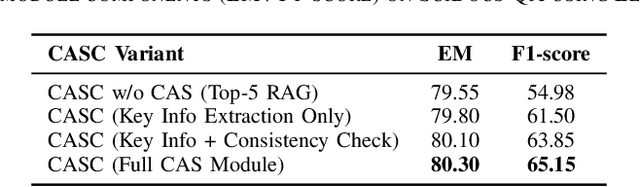

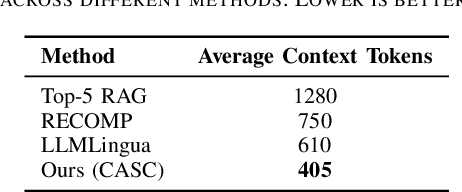
Large Language Models (LLMs) excel in language tasks but are prone to hallucinations and outdated knowledge. Retrieval-Augmented Generation (RAG) mitigates these by grounding LLMs in external knowledge. However, in complex domains involving multiple, lengthy, or conflicting documents, traditional RAG suffers from information overload and inefficient synthesis, leading to inaccurate and untrustworthy answers. To address this, we propose CASC (Context-Adaptive Synthesis and Compression), a novel framework that intelligently processes retrieved contexts. CASC introduces a Context Analyzer & Synthesizer (CAS) module, powered by a fine-tuned smaller LLM, which performs key information extraction, cross-document consistency checking and conflict resolution, and question-oriented structured synthesis. This process transforms raw, scattered information into a highly condensed, structured, and semantically rich context, significantly reducing the token count and cognitive load for the final Reader LLM. We evaluate CASC on SciDocs-QA, a new challenging multi-document question answering dataset designed for complex scientific domains with inherent redundancies and conflicts. Our extensive experiments demonstrate that CASC consistently outperforms strong baselines.